Ian Sollom MP writes about the Planned Jodrell Bank Observatory Closure for the Cambridge Independent
Originally written for the Cambridge Independent Column – August 2026
Jodrell Bank Observatory is facing closure. Most people know the observatory in passing – quite literally: the vast dish of the Lovell Telescope is visible from the M6, an accidental landmark become icon. It remains the third largest steerable radio telescope in the world and is a UNESCO World Heritage site. Sitting in Cheshire, twenty miles south of Manchester, it is run by the university whose city Andy Burnham used to govern. Under cuts to research budgets, its future now hangs in the balance.
Radio astronomy doesn't often make headlines. This is one of the rare occasions it has, and for the worst possible reason.
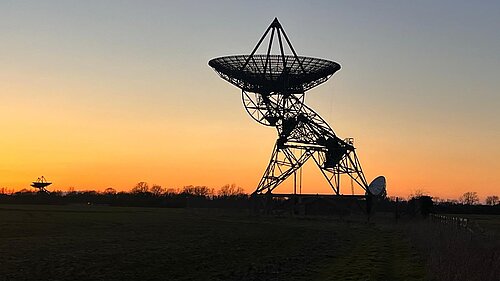
Just outside Cambridge, on the way to Wimpole at Lord's Bridge, sit the dishes of the Mullard Radio Astronomy Observatory (MRAO) – less visible from the road, but part of the same tradition of fundamental physics as Jodrell Bank. I wasn't directly involved in radio astronomy, but I was technically part of MRAO while completing my PhD at the Cavendish Laboratory and was there for its 50th anniversary in 2007. Some of the people I worked alongside then are still in the field, a few now contributing to the Square Kilometre Array (SKA), the next-generation radio telescope being built in South Africa and Australia. Others took the analytical and technical skills they learned into technology startups, AI, finance, and – in my case – politics. Whether we stayed in the field or not, we've watched this crisis building with growing alarm.
Jodrell Bank is the most visible symbol of it, but far from the whole story. The Science and Technology Facilities Council (STFC), which funds particle physics, astronomy and nuclear research, has been told to find £684 million in savings over the current spending review period. Among the casualties: the UK's upgrade programme for LHCb, one of the four main experiments at CERN's Large Hadron Collider, which has produced more scientific discoveries since 2010 than any other experiment in particle-physics history.
The upgrade was awarded £45 million from UKRI's infrastructure fund in 2022, which triggered a further £118 million in commitments from international partners – exactly the kind of leverage on public money that UKRI's own strategy is supposed to be chasing. STFC's own science advisory board recommended it for continued funding; its executive turned it down anyway. Around 250 UK researchers, students, technicians and engineers work on the collaboration; cancelling the upgrade effectively ends the UK's role in the experiment's future just as it enters its most productive phase, having recorded only a fifth of the data it was built to collect. Questioned by the select committee scrutinising the decision, one MP put the sum in context: against the whole of the government's budget, it is "a rounding error for the Treasury."
And this matters beyond any single project. Long-term international science relies on stable commitments made with partner countries. Break one, and you don't just lose your seat at the table. Pressed on the point by the same committee, STFC's own executive chair conceded as much: the decision, she admitted, "certainly weakens our standing."
The timing at Jodrell Bank is particularly painful. It was the lead observatory in a network of pathfinder facilities that helped develop the techniques and train the people the SKA will depend on. Defunding it just as the SKA comes online is to walk away from the field at the moment of its greatest opportunity. Britain pioneered radio astronomy – here in Cambridge, Martin Ryle won a Nobel Prize for the techniques that underpin how the SKA itself works.
The government's defence is that it's reorienting research funding towards applied outcomes – AI, quantum computing, the technologies of its industrial strategy. That sounds reasonable, until you look at where those technologies actually came from.
In the June issue of my Cavendish alumni magazine, Matt Kenzie, associate professor in the Cavendish High Energy Physics group, made the point well: the trapped-ion quantum computing technology that the US firm IonQ acquired from Oxford Ionics for $1.075 billion came directly from atomic and particle physics research – the kind of curiosity-driven work that, under the government's current filter, would likely not have survived. The World Wide Web came from a particle physics laboratory. MRI came from nuclear magnetic resonance. Nobody planned those outcomes. They emerged because talented people were given the freedom and the funding to follow difficult questions without knowing in advance where the answers would lead.
This is what Jodrell Bank and experiments like LHCb have always done – not just producing discoveries but producing people: the engineers trained on detector technologies, the postdocs who learn to handle vast datasets, the students who walk into careers in AI or semiconductor design carrying skills developed in service of a question with no commercial application in mind. Strip out the pipeline and you don't just lose the research. You lose the people the strategy depends on. And the department that existed to make that argument inside government, DSIT, no longer does: it was folded this summer into a business-and-trade department whose priorities are, by design, more applied than curious.
Whoever makes the case for curiosity-driven science from now on will be making it from inside a department not built to hear it.
Jonathan Reynolds, that department's new Secretary of State, said last week that world-class research was "absolutely central to creating a better future for the UK." He's right – which makes it harder to explain why the decisions currently in front of him point the other way. They can still be reversed. Not for much longer.
Andy Burnham's government has an early opportunity to say something clear about what kind of science nation Britain intends to be. Jodrell Bank belongs to the university at the heart of the city he governed for the better part of a decade. So, does Manchesterism include Jodrell Bank?